Forming a US LLC & Getting an EIN
State Choice, Registered Agents, Operating Agreements, EINs for US and Non-US Founders, BOI Status in 2026, Banking, and Annual Compliance
Business Basics · $0.99 PDF guide
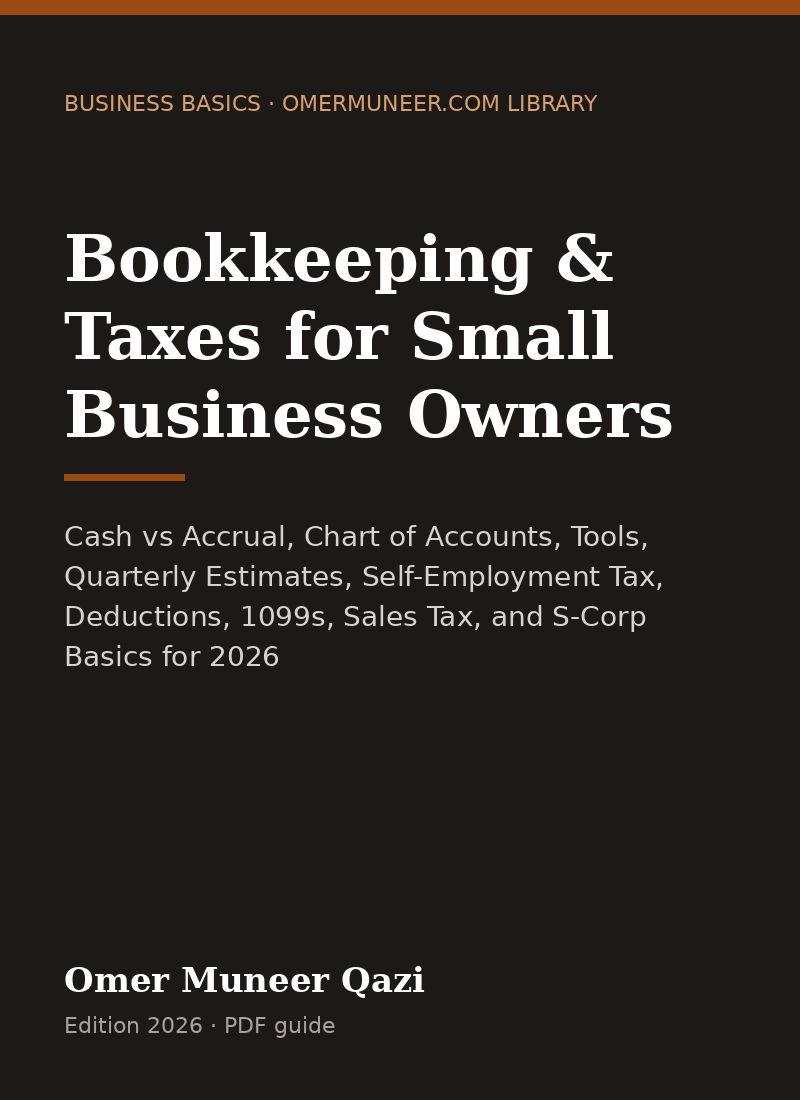
Cash vs Accrual, Chart of Accounts, Tools, Quarterly Estimates, Self-Employment Tax, Deductions, 1099s, Sales Tax, and S-Corp Basics for 2026
14 chapters · about 9,168 words (~31 pages) · instant PDF download · by Omer Muneer Qazi
Free sample · chapter 1 in full
Bookkeeping is recording every financial transaction your business makes, in categories, so you can produce accurate financial statements and tax returns. Accounting is interpreting those records. You can do the bookkeeping yourself; most owners benefit from a professional for tax returns and planning.
Every transaction affects at least one of these five account types:
| Type | What it is | Examples |
|---|---|---|
| Assets | What the business owns | Cash, accounts receivable, equipment, vehicles, inventory |
| Liabilities | What the business owes | Credit card balances, loans, sales tax collected but not yet paid, accounts payable |
| Equity | The owner's stake | Owner contributions, owner draws, retained earnings |
| Income (revenue) | Money earned from customers | Service income, product sales |
| Expenses | Costs of running the business | Rent, fuel, software, wages, advertising |
The basic accounting equation ties them together: Assets = Liabilities + Equity. Profit (income minus expenses) increases equity; owner draws decrease it.
| Approach | Owner time per week | Typical cost (as of 2026, varies by region and volume) |
|---|---|---|
| DIY with software | 1–2 hours | Software roughly $0–$100/month |
| Part-time bookkeeper | 15–30 minutes (review and questions) | Often $200–$800/month for a small business |
| Bookkeeping plus tax service | 15 minutes | Often $300–$1,500+/month depending on complexity |
| Annual tax return preparation | — | Schedule C returns often a few hundred to around $1,000; partnership or S corporation returns often $1,000–$3,000+ |
Keep reading in the full guide.
Buy the PDF — $0.99Free guide
A simple bookkeeping system for small businesses: separate accounts, chart of accounts, receipts, monthly reconciliation, reports, quarterly estimated taxes and 1099s.
Many small business owners do their own bookkeeping with accounting software, especially in the early years. A simple monthly routine is usually enough. Many still use a tax professional for returns and planning.
For individuals, federal estimated tax payments are generally due around April 15, June 15, September 15 and January 15 of the following year, adjusted when a date falls on a weekend or holiday. Check IRS.gov for current dates.
The IRS generally recommends keeping records that support items on a tax return for at least three years, and longer in certain situations, such as employment tax records or if income was underreported. Many owners keep records for seven years.
A downloadable PDF of the complete guide, including every chapter, checklist, worksheet and template listed in the table of contents. There is no subscription.
Checkout is handled by a secure payment provider. Your download link appears right after payment and is also sent to the email address you enter at checkout.
Yes. If the file is defective or not what was described, email within 14 days of purchase and you will get a refund. See the refund policy for the details.
State Choice, Registered Agents, Operating Agreements, EINs for US and Non-US Founders, BOI Status in 2026, Banking, and Annual Compliance
A Step-by-Step 2026 System for Verification, Reviews, Local Services Ads, Citations, Nextdoor, Facebook, Referrals, and Scripts That Win Nearby Customers
A Beginner's Guide to Pre-Licensing, the Exam, Choosing a Brokerage, Buyer Agreements After the NAR Settlement, and Your First Year of Deals
Every chapter, checklist, worksheet and template in one PDF. Read it tonight, act on it tomorrow.
Buy the PDF — $0.99General information, not legal, tax or financial advice. Rules vary by state. See the disclaimer and refund policy.